
Solid vs Hollow Core Bedroom Doors: Which Is Better?
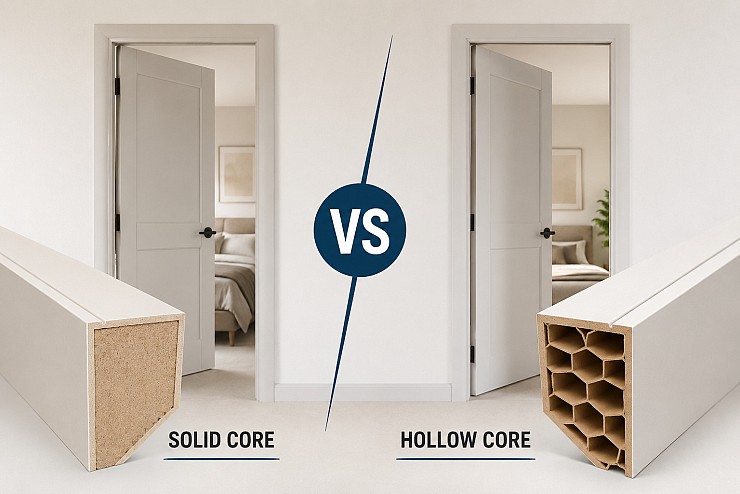
Bedroom doors are no longer treated as simple interior partitions in modern Toronto homes. They influence acoustic comfort, room separation, durability under daily use, and how quiet a living space feels overall. Because of this, choosing between solid core and hollow core bedroom doors is a technical decision, not just a design preference.
For renovation and Replacement doors Toronto projects, especially in homes where interior upgrades are coordinated with exterior systems like steel doors or fiberglass doors Toronto, understanding door construction becomes important. A professional door supplier Toronto such as Delco Windows & Doors often works on full-property upgrades that include both interior and exterior door systems for consistent performance.
Understanding Core Construction at a Structural Level
The key difference between solid core and hollow core doors is not appearance or surface finish. It is how the internal structure behaves under sound pressure, vibration, and long-term use.
Solid Core Bedroom Doors
Solid core doors are manufactured using engineered wood, composite layers, or dense particle-based materials. This creates a high-mass internal structure that behaves differently under acoustic load.
From a technical perspective:
- Higher density reduces vibration transmission
- Internal mass absorbs airborne sound energy more effectively
- Improved stability under seasonal humidity changes
- Better load distribution across hinges and frame
This is why solid core doors are often specified in projects where acoustic separation between rooms is important, especially in homes undergoing broader upgrades involving custom doors in Toronto or coordinated interior design improvements.
Hollow Core Bedroom Doors
Hollow core doors use a lightweight internal honeycomb or grid system.
Technically:
- Low mass allows easier sound penetration
- Internal cavities can amplify resonance
- Frame and installation quality become critical performance factors
- Limited long-term acoustic stability
These doors are typically used in closets or low-use interior spaces rather than primary bedrooms.
STC Rating and Acoustic Performance
A key technical measure in door performance is STC (Sound Transmission Class) rating, which evaluates how effectively a door reduces airborne sound transfer.
Typical STC Ranges:
- Hollow core doors → STC 20 to 25 (normal speech is clearly audible through the door)
- Solid core doors → STC 30 to 35+ (speech becomes muffled and less distinct)
- High-performance sealed systems → STC 40+ (strong sound isolation used in premium interiors)
However, STC performance is not determined by the door alone. It depends on the entire system:
- Door core density
- Frame sealing quality
- Perimeter gaps
- Hinge alignment
- Threshold installation
Even a solid core door will not perform at its potential if air leakage is present around the frame.
This system-based thinking is also seen in exterior applications like sliding patio door Toronto systems and lift and slide doors Toronto installations, where sealing and structural precision directly influence acoustic and thermal performance.
Sound Transfer in Real Home Conditions
Sound does not move through a door in only one way. It follows multiple transmission paths:
- Direct airborne passage through the door panel
- Vibration transfer through hinges and frame
- Leakage through bottom and side gaps
- Resonance inside hollow internal structures
Solid core doors reduce vibration-based transmission due to higher mass. Hollow core doors, by contrast, allow more resonance and sound movement through their internal cavities.
This is why installation precision plays a major role in real-world performance.
Installation Quality and Performance Reality
Even high-quality doors can underperform if installation is not precise.
Common issues include:
- Uneven frame alignment
- Unsealed perimeter gaps
- Improper hinge load distribution
- Missing bottom sweep or threshold control
These factors significantly reduce effective STC performance in real environments.
The same principle applies in exterior systems such as storm door in Toronto installations and aluminum storm doors in Toronto, where storm door installation Toronto quality directly affects air sealing, noise control, and energy performance.
Long-Term Structural Behavior
| Characteristic | Solid Core Doors | Hollow Core Doors |
|---|---|---|
| Rigidity over time | Maintain rigidity | More vulnerable to edge damage |
| Warping resistance | Less prone to warping under humidity changes | Can deform under repeated impact |
| Impact resistance | Better resistance to daily impact | Depend heavily on frame stability |
| Hinge alignment | Stable under long-term use | Limited long-term structural consistency |
In full-home upgrades where homeowners also install Toronto entry doors or garden doors, consistency in door performance across interior and exterior systems becomes important.
Role in Modern Toronto Homes
Modern Toronto homes often include:
- Condos with shared walls
- Townhouses with close living spacing
- Basement rental units
- Multi-purpose bedrooms used as workspaces
In these environments, acoustic separation becomes a functional requirement rather than a preference.
Solid core doors contribute to:
- Reduced cross-room noise transfer
- Better focus in home office environments
- Improved sleep quality in shared households
This is why they are often selected alongside broader exterior upgrades such as steel doors and fiberglass doors Toronto installations, where durability and performance are equally important.
Larger opening systems like sliding patio door, lift and slide doors, and garden doors also follow the same principle of balancing structure, sealing, and acoustic behavior.
When Hollow Core Doors Still Work
Hollow core doors remain suitable in situations where:
- Sound control is not critical
- Rooms have low usage frequency
- Budget limitations are a priority
- Lightweight design is required
However, in performance-focused renovation projects involving replacement doors in Toronto or system-wide upgrades from a door supplier Toronto, hollow core doors are usually not selected for primary bedrooms.
Key technical insight: A solid core door functions as a medium-density acoustic barrier with higher STC performance, improved vibration control, and stronger long-term stability. A hollow core door functions as a lightweight partition with limited acoustic resistance and higher sound permeability.
Final Technical Evaluation
From a performance engineering perspective:
- Solid core doors function as medium-density acoustic barriers with higher STC performance, improved vibration control, and stronger long-term stability.
- Hollow core doors function as lightweight partitions with limited acoustic resistance and higher sound permeability.
For Toronto homeowners planning full renovation projects involving custom doors in Toronto, steel doors, fiberglass doors Toronto, and coordinated exterior systems like storm door installation Toronto, solid core bedroom doors align more closely with modern expectations of comfort, durability, and acoustic separation.
Conclusion
The difference between solid and hollow core bedroom doors is not simply a material comparison. It is about how each system manages sound energy, vibration behavior, and long-term structural performance inside a home.
When evaluated through STC performance, installation quality, and real-world use in modern Toronto housing, solid core doors consistently deliver stronger acoustic control and more stable long-term results, making them the preferred option for primary bedroom applications.
Upgrade Your Bedroom Doors for Better Comfort and Quiet
Whether you're renovating a single room or planning a full-home upgrade, choosing the right interior doors makes a measurable difference in daily comfort. Delco offers expert guidance and premium door solutions for both interior and exterior applications across Toronto.
Frequently Asked Questions
Can I hear conversations through a solid core door?
Solid core doors significantly muffle speech, making words less distinct, but very loud sounds may still be audible. For complete sound isolation, you would need a combination of a solid core door plus proper perimeter sealing and acoustic framing.
Are solid core doors heavier than hollow core doors?
Yes, significantly. A typical solid core door weighs 70–100 lbs, while a hollow core door weighs 20–30 lbs. This weight difference affects hinge selection and installation requirements.
Do solid core doors help with heating and cooling?
Yes, their higher density provides better thermal insulation between rooms, which can help maintain consistent temperatures and reduce HVAC load, though the effect is more modest than acoustic benefits.
Is it worth replacing hollow core bedroom doors with solid core?
For primary bedrooms, home offices, or media rooms, yes. The improvement in sound reduction, perceived quality, and durability typically justifies the investment, especially in shared households or multi-generational homes.